
Introduction
The Protestant Bible consists of 66 different writings written by 40 authors who wrote under the inspiration of God. These writings were written over the course of 1500 years ((1400 BC – AD 100). During that time period empires came and went.
NOTE: In some traditions, only some of the authors are designated as saints (those who are “set aside”), although in the Book of Acts, all believers are called saints – that is, people God set aside for his purpose. However, in the Roman Catholic church, the term “saint” became restricted to only those notable people whom the church had selected to be set aside.
The Bible is a product of God who inspired various people to write his thoughts into their human language. Those manuscripts were then preserved by others who assembled, compiled, and sometimes translated them. It was only those manuscripts that God’s people recognized as inspired by God that were put together as a library that today we call the Bible.
Lands of the Bible
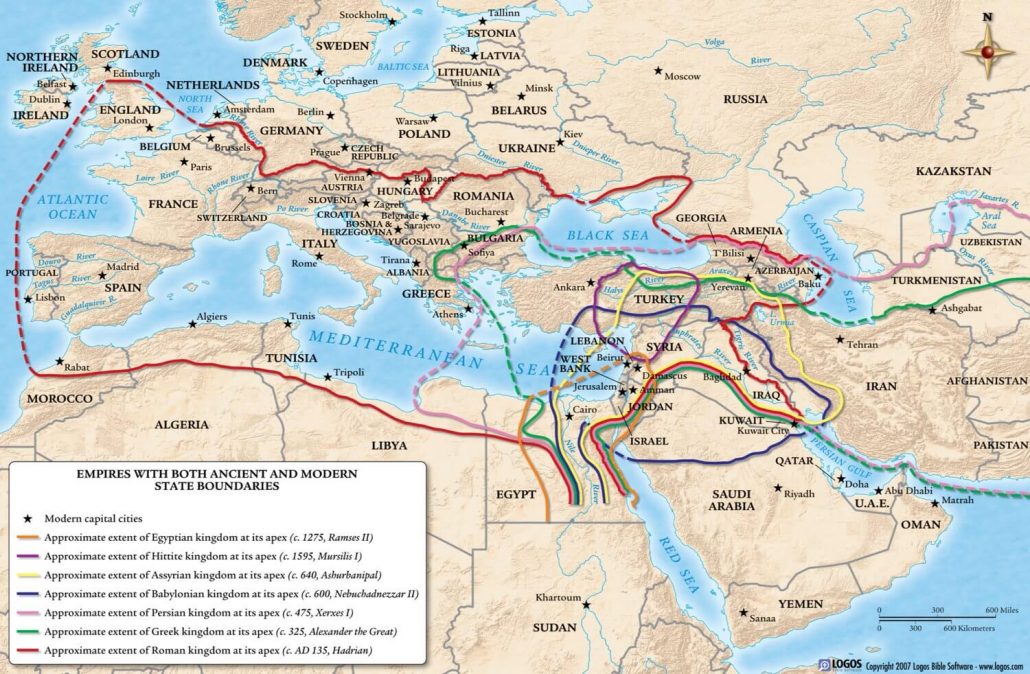
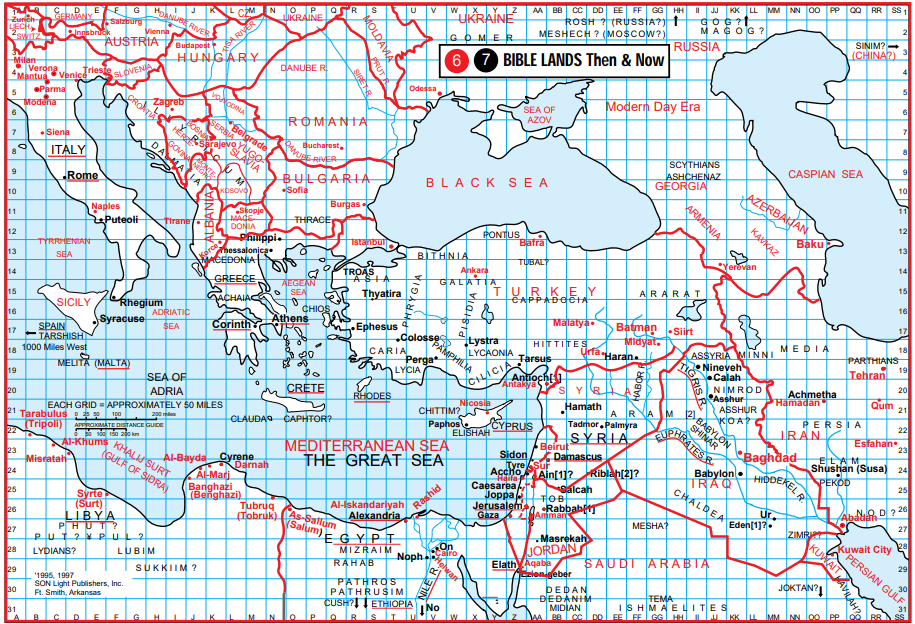
The maps below may help to show how the lands mentioned in the Bible line up with modern day maps.
This map is from slide 1 of www.understandchristianity.com/timelines/chronology-latter-prophets-intertestamental-period. The empires in this map do not extend back to Abraham’s time, but it does give a good ideas about how the “Promised Land” was continuously overrun by one empire after another
The following map is from Understand Christianity, Chronology of Latter Prophets and Intertestamental Period
The following map is from slide 10 of media.sabda.org/alkitab-10/LIBRARY/REFERENC/SON_MAPS.PDF. This map show how modern-day countries overlay cities and other areas of the Biblical world.
Languages of the Bible
The Bible was originally written mostly in Hebrew (Old Testament) and Greek (New Testament) with some passages written in Aramaic.
Those Biblical writings were written on paper/papyrus or animal skins which, apart from occasional exceptions, were not going to last very long. As a result, we do not have any copies of the original writings. Fortunately, so many copies had been made that some very old copies were able to survive.
These hand-written copies (all copies written before the age of the printing press are hand-written) are called manuscripts. Some of these old manuscripts are written in different languages:
- Latin: Latin was the official language of the Roman Empire. The Vulgate Bible was a Latin translation completed by Jerome in 405 AD although he was always revising it. The Vulgate was used by the church in the Western Roman Empire and was it was made the official Roman Catholic Bible in 1546 (overviewbible.com/vulgate).
- Syriac: Syriac is a dialect of the Aramaic language. It was the main literary language of the early Christian communities in Ancient Syria. The Old Testament version of the Peshitta Bible was written in 2nd century AD and the New Testament version was completed in the 5th century. The Peshitta is still the standard version of various churches today (Ex: Maronite, Chaldean Catholic, Syriac Catholic, Syriac Orthodox)
- Greek: Greek was, of course, language of Greek Empire but it also remained the international trade language of the Roman Empire. The Septuagint Bible was translated around 250 BC by 70 Jewish scholars.
- Other old translations were also made (Ex: Coptic (Egypt and Ethiopia), Armenian)
Versions vs. translations
A translation is the conversion of a text from one language to another. A version is a specific form or variation of something, including translations. Some languages only have one version of the Bible available to them. The English language has many, many versions available using different styles of interpretation. Each style has its advantages.
There are four common ways of categorizing these styles.
- Formal or literal or word-for-word. Attempt to do, as much as possible a word for word translation. This style tries to maintain the sense of the original wording, but in the extreme, can be very awkward to read and require some extra helps for the average Bible reader to understand. (Ex: KJV, NKJV, ESV, NASB). The strictest form may be seen in an interlinear Bible where the original wording is written in parallel with the translation.
- Functional or dynamic or thought-for-thought. Stresses less the grammatical form of the original and stresses more the rewording of expressions that are understood by modern readers. (Ex: NIV, HCSB, NAB).
- Optimal or balanced. Tries to stress the use of both the formal and functional styles.
- Paraphrases. A more extreme form of the functional /dynamic equivalent translation. (Ex: JB Phillips, TLB, Message, Amplified). To be transparent about its translation style, the Amplified version puts words in brackets and parenthesis to indicate when it has added words that are not in the original but are used to “amplify” the nuances of the original. It’s like pulling footnotes from the bottom of the page and inserting those notes right in the text itself. (www.logos.com/grow/use-not-use-amplified-bible).
Word-for-word translations are best for in-depth study but can be difficult to understand. Thought-by-thought translations are easier to understand but are more subject to the translator’s biases and misunderstandings. Using multiple translations helps to more fully understand the text. The links below will point to different images that show how different people see how the different versions of the Bible compare to each other.
- www.swapmeetdave.com/Bible/BibleType.htm
- csbible.com/about-the-csb/translation-philosophy
- notjustanotherbook.com/biblecomparison.htm
- godsword.org/pages/bible-translation-guide
No translation uses totally one technique. Publishers who claim “optimal equivalence” basically want to claim they use a “balanced” approach. Paraphrases are sometimes lumped with “thought-by-thought” translations but are sometimes listed in a separate category as more freely translated versions usually written by a single author. Bible translation methods range along a continuum from word-for-word to thought-for-thought. Either extreme is not desirable: a fully word-for-word translation would seem clumsy and difficult to understand, a fully thought-for-thought would be extremely wordy if it tried to capture all the nuances of the original language. There is also the added complexity of choosing which grade level of language to use. No single translation works for all circumstances. Claims of any translation to be optimal are simply choosing which optimal point they are aiming at. An interesting variation of translations are those Bibles available that do not have chapter and verse assignments which allow one to read Biblical text more in the manner in which it was written. Bible reading should not be focused on finding quick answers for particular problems, but rather understanding the mind of God that we might become more like him. To read scripture we should seek to understanding not just the text but the context which includes among many other things who is writing to whom about what situation using what literary forms.
Literary genius of the Bible
On the one hand, ever since the Protestant Reformation, the claim has been that the Bible is “perspicuous.” That is, the basic content of the Bible is understandable by the average reader. On the other hand, there is content in the Bible that is baffling to the best Bible scholars. Of course, much of the Bible is in-between those extremes. But what is certain is how many ways the Bible has the character of a literary masterpiece, some characteristics are still being discovered. To begin to see this aspect see transcendenttouched.com/2023/04/25/the-literary-bible.
Expect that when studying/reading the Bible, that some things will be straightforward, some will require studying to understand and some things will remain confusing. There is no one Bible version that is best, except to say that, “the best Bible version to use is the Bible version you’ll read.” For Bible study purposes though, it is probably helpful to have different versions available from each style to take advantage of the scholarship of each translation.
Hearing the word
Before the printing press (created first in China and then in Europe by Johannes Gutenberg in 1450), the average person did not have access to a written Bible. Most people “heard” the Bible as it was read out loud. Reading silently was not common until the 1800s (qz.com/quartzy/1118580/the-beginning-of-silent-reading-was-also-the-beginning-of-an-interior-life).
Because reading out-loud was sometimes done in noisy situations a chanting/singing style of reading used in order to be better heard. In the first century AD, Rabbi Akiva demanded that the Torah be studied by means of chant on a daily basis (www.myjewishlearning.com/article/cantillation-chanting-the-bible). The church picked up this practice in a style known as the Gregorian chant.
Additionally, to help people learn and memorize the Bible, the Old Testament used various literary techniques such as poetry, alliteration, and repetition; many of which can only be seen in the original Hebrew.
Books of the Bible
In the Old Testament times, writings were recorded on individual scrolls – so the Old Testament Bible would truly looked like a library of scrolls (or books). In New Testament times, codex was developed, which looks a lot like modern day books. The codex was capable of holding all the writings in one bound copy. Different church traditions have disagreed on which writings (books/scrolls) to include in the Bible – this list is called the canon. The Protestant tradition includes 37 books in the Old Testament and 25 in the New Testament. The Catholic, Eastern Orthodox and Oriental Orthodox traditions include some additional books which they call the Deuterocanonical (second canon) books but are called the Apocrypha (hidden) books in the Protestant tradition which, in those Protestant traditions that use them, are considered useful for instruction but are not inspired. One part of the Apocrypha, the Maccabees, we see the historical account that led to the celebration of Hannukah (festival of Dedication), which was observed by Jesus (John 10:22). More details on those books can be found at dancinginthekingdom.com/2024/01/06/appendices-2.
Sometimes people anonymously write texts that try to give them authenticity by falsely claiming to be written by a Bible figure. Examples of such texts, called pseudopigraphs are “Book of Enoch” and “Book of Daniel.” In more modern times, some authors try to give their works authenticity by claiming to be inspired by God or by angels. Examples of such texts are: The Book of Mormon (In 1844, Joseph Smith claimed that the book was dictated by an angel called Moroni). The Quran (From AD 610-632, a prophet called Mohammed claimed the book was revealed to him by an angel called Gabriel).
Biblical Inerrancy
According to the Baptist Faith and Message:
(www.calvarybaptistseymour.org/uploads/1/5/4/7/15476090/what_do_baptists_believe.pdf)
The Holy Bible was written by men divinely inspired and is God’s revelation of Himself to man. It is a perfect treasure of divine instruction. It has God for its author, salvation for its end, and truth, without any mixture of error, for its matter. Therefore, all Scripture is totally true and trustworthy. It reveals the principles by which God judges us, and therefore is, and will remain to the end of the world, the true center of Christian union, and the supreme standard by which all human conduct, creeds, and religious opinions should be tried. All Scripture is a testimony to Christ, who is Himself the focus of divine revelation.
This leads to 6 central truths.
First, the Bible is DIVINELY INSPIRED. The word “inspiration” in the original language means “God breathed”. This is to say, the Bible contains the very words or “breath” of God. Through the Person of the Holy Spirit, God used men as instruments to physically write down the words, while ensuring that each was written exactly as He desired. God alone was and is fully responsible for the content of the Bible. He is its Author, and He reveals Himself to us through its text.
Second, the Bible is TOTALLY TRUE. Stated another way, it is inerrant without any error. There are no contradictions, misstatements, falsehoods, half-truths, or mistakes of any kind. Every word is absolutely true. Any perceived errors or misunderstandings of the Scriptures that we may recognize are the result of our own limited knowledge and improper interpretation. When understood correctly, there is no discrepancy or conflict.
Third, the Bible is SOLELY AUTHORITATIVE. This means that it is the only source of divine instruction there are no other books, testaments, documents, decrees, creeds, or any other writings or religious opinions that are accepted as God’s Word. It stands alone as the supreme authority by which all other ideas, thoughts, principles, traditions, and the like are measured. Nothing supersedes or even equals the authority of the Bible.
Fourth, the Bible is COMPLETELY SUFFICIENT. There is nothing left out of it that needs to be added, nor is there anything included in it that does not belong. The Bible’s content is perfectly complete just as it is, and is sufficient in its revelation so that mankind may to know and live for God just as He desires.
Fifth, the Bible is RELEVANT AND TIMELESS. The principles and teachings contained in the Bible are eternal, and therefore have application to people of all generations. The Word of God is “living” meaning that it is always current and fresh. It endures forever, never fading or becoming obsolete. It is as relevant today as it was when it was written and will remain relevant for all eternity. The Bible is not what God said, it is what He is saying.
Sixth, the Bible is ALL ABOUT JESUS. The writings of the Old Testament prophecy the coming of Christ, the Gospels tell of His life & ministry on earth, the New Testament describes the growth of the Church after the death & resurrection of Christ, and they also point to His triumphant return at the end of this age. The entire Bible is a testimony of Jesus Christ and in Him alone we discover its ultimate meaning and purpose.

 Transcendent Touched